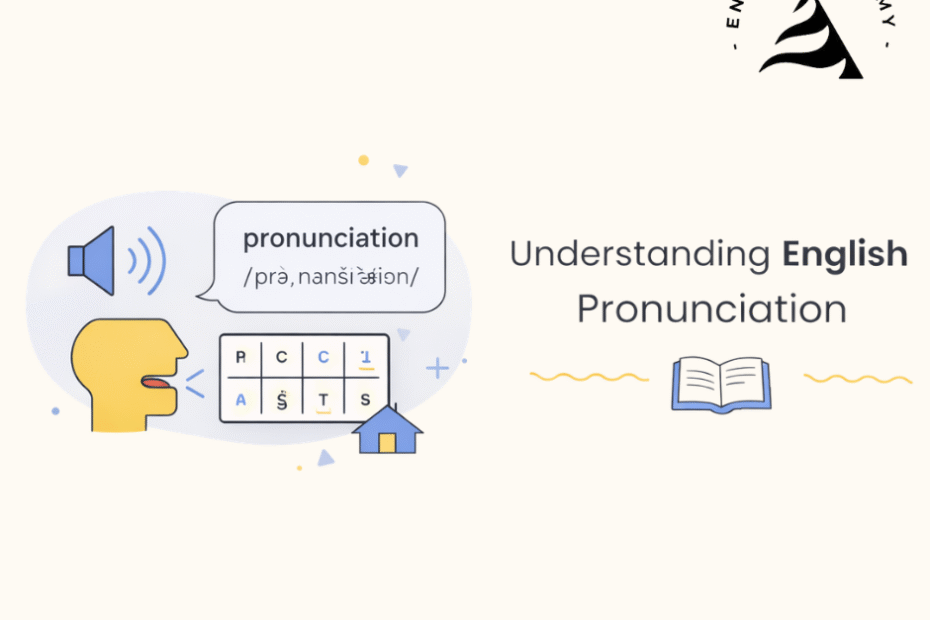
Understanding English Pronunciation
/pruh-nun-see-AY-shun/
Voiced and voiceless consonants
To understand the principle behind the phonological phenomenon, you must first understand the concept of voiced and voiceless consonants in English. Voiced consonants are the ones that, when pronounced, the vocal cord vibrates or sort of rumbles. Such consonants are b, d, g, v, z, m, n, l, r etc. If you place the back of your hand on you neck below the chin as you pronounce any of them, you feel the rumbling or vibration. On the other hand, the voiceless consonant is the one that does not record vibration when being pronounced. These include h, p, k, f, s, t. Repeat the exercise and you will not notice vibration.
There are 15 voiced consonants and 9 voiceless consonants in English and there are 24 consonant sounds. Some consonants can be voiced in one word while voiceless in another word. Furthermore, many of these sounds can be represented by more than one letter or combination of letters. These combinations of letters that represent a single sound are called digraphs. Additionally, when two or more consonant sounds are blended together in a way that the sound of each consonant can be recognised individually, this is called a consonant blend. (I’ve written a separate article on consonant blends and digraphs. Here we will see voiced and voiceless sounds)
Here is the list of voiced and voiceless sounds
Voiced consonant Sounds:
- b /b/ (as in "bat")
- d /d/ (as in "dog")
- g /ɡ/ (as in "go")
- v /v/ (as in "van")
- z /z/ (as in "zip")
- s(zh) /ʒ/ (as in "pleasure")
- j /dʒ/ (as in "jug")
- m /m/ (as in "man")
- n /n/ (as in "no")
- ng /ŋ/ (as in "sing")
- l /l/ (as in "let")
- r /r/ (as in "run")
- w /w/ (as in "we")
- y /j/ (as in "yes")
- th /ð/ (as in "this")
Note: j is phonetically written as /dʒ/.
y is phonetically written as /j/
Voiceless consonant sounds:
- p /p/ (as in "pin")
- t /t/ (as in "top")
- k, ch /k/ (as in "key" and “chemist”)
- f /f/ (as in "fish")
- s /s/ (as in "sit")
- ch, sh /ʃ/ (as in "ship" and “machine”)
- ch /tʃ/ (as in "church")
- h /h/ (as in "hat")
- th /θ/ (as in "think")
Note: 3 different sounds of ch, 2 different sounds of s and that of th.
Pronunciation of ‘ed’ at the end of words
Rule 1: When the consonant before the ‘d’ is voiced, you pronounce it as D:
Robbed – /robD/: They robbed the bank yesterday.
Begged – /begD/: They begged me but I refused to go.
Named – /namD/: I learnt he was named after his grandfather.
Rule 2: When the consonant before the ‘d’ is voiceless, you pronounce it as T:
Talked – /talkT/: I talkT to him
Tapped – /tappT/: We tapT from his wealth of knowledge.
Rule 3: The third type is realised when you have ‘ted’ or ‘ded’ etc. ending the past tense word – like wanted, rented, dented, cemented; ended, wicked, hounded, rounded etc. In this case, the words are pronounced as wantID, endID etc.
Wanted: /wantID/: They wantID to leave in the morning.
Amended: /amendID/: Have they amendiD the Constitution?
Silent letters
Silent A
A is not pronounced in many adverbs, where the words ends in –ally. It is also silent in some words that have ‘ea’ and some random words.
- Logically
- Artistically
- Critically
- Physically
- Musically
- Bread
- Dread
- Thread
- Aisle/eye-l/
- Aesthetics
- Mountain
Silent B
When a word ends with ‘mb’, then b is silent. The letter b is silent before t
- Plumber (Plumb)
- Comb
- Tomb
- Bomb
- Climb, climber
- Thumb
- Numb
- Subtle
- Debt
- Doubt
Silent C
In words where ‘sc’ is there, c is silent.
- Ascent
- Scent
- Descent
- Muscle
- Disciple
- Discipline
- Fluorescent
- Crescent
- Conscience
- Conscious
Silent D
In words with ‘nd’ and ‘dg’, the letter d is silent.
- Sandwich
- Handsome
- Handkerchief
- Edge
- Wedge
- Hedge
- Ledge
- Badge
- Bridge
- Ridge
Silent G
‘G’ is silent before ‘n’.
- Design
- Campaign
- Resign
- Foreign
- Cologne
- Gnaw
- Gnarl
Silent H
- Hour
- Honest
- Overwhelm
- What
- When
- Whether
- Why
- While
Silent K
‘K’ is silent before ‘n’
- Knack
- Knee
- Knife
- Knit
- Knob
- Knot
- Know
- Knuckle
Silent L
‘L’ is silent before ‘m’ and in some other words.
- Almond
- Balm
- Calm
- Palm
- Realm
- Salmon
- Folk
- Talk
- Calf
- Half
Silent N
When a word ends with ‘mn’, then n is silent.
- Column
- Autumn
- Damn
- Hymn
- Solemn
Silent O
- People
- Jeopardy
- Leopard
- Double
- Rough
Silent P
- Psychology
- Psychiatry
- Pseudo
- Pneumonia
- Psalm
- Receipt
- Cupboard
- Corps
- Coup
- Raspberry
- Empty
Silent S
In many words S is silent after i
- Aisle
- Island
- Islet
- Debris
- Viscount
Silent T
‘T’ is silent in the following cases:
- After ‘S’
- Castle
- Nestle
- Listen
- Hasten
- Fasten
B. After ‘F’
- Often
- Soften
C. Before ‘ch’
- Watch
- Witch
- Match
- Butcher
- Scratch
D. At the end of French-origin words
- Buffet
- Valet
- Rapport (build a rapport)
- Ballet
Silent W
W is silent in words that begin with ‘Wr’ and also in some other common words
- Wrap
- Wrath
- Wrong
- Write
- Wrist
- Wrestle
- Wrench
- Answer
- Sword
- Playwright
Commonly mispronounced words:
Each word is followed by its pronunciation tip, with the stressed syllable in CAPITALS. Many words (heteronyms) have two different meanings and pronunciations- one as a noun and the other as a verb or an adjective. The general rule is that a noun has stress on the first syllable whereas a verb or an adjective has stress on the last or second-last syllable. Example: CON-tent (noun) and con-TENT (adj.)
- Banquet /BAN-quet/
- Bouquet /bou-KET/
- Breakfast /BREAK-fast/
- Wednesday /WENS-day/
- Data /DAY-ta/
- Debut /DEB-yoo/
- Debuted /DEB-yood/
- Debris /deb-REE/
- Dengue /DENG-ee/
- Determine /de-TER-min/
- Nazi /NAAT-zi/
- Pizza /PIT-za/
- Naïve /naa-EEV/
- Niche /NICH/ or /NEESH/
- Gauge /GEYJ/
- Expresso /es-PRESS-oh/
- Chaos /KEY-os/
- Suite /SWEET/
- Suicide /SWI-cide/
- Suede /SWED/
- Sour /SAA-ur/
- Bowl /BOHL/
- Woman /WU-mun/
- Women /WIH-men/
- Man /MAN/
- Men /MEN/
- Epitome /ih-PIT-uh-mee/
- Jalapeño /HEL-uh-pee-no/
- Vegetable /VEJ-tabl/
- Colleague /KOL-eeg/
- Position /pu-ZI-shun/
- Possession /pu-ZE-shun/
- Menu /MEN-yu/
- Develop /de-VEL-up/
- Salon /say-LAWN/
- Vineyard /VIN-yerd/
- Restaurant /RES-trawnt/
- Buffet /boo-FAY/
- Dessert /di-ZERT/
- Sandwich /SAN-wich/
- Envelop /EN-ve-lup/
- Envelope /EN-ve-lop/ or /ON-ve-lop/
- Entrepreneur /ahn-truh-pruh-NUR/
- Ensemble /on-SOMB/
- Entourage /ON-tuh-raazh/
- Crèche /CRECHE/
- Charisma /ka-RIZ-maa/
- Gigantic /jai-GAN-tic/
- Regime /reh-ZHEEM/
- Biology /by-OL-uh-jee/
- Technology /tek-NOL-uh-jee/
- Archive /AR-kive/
- Cucumber /KYOO-cum-buh/
- Echelon /EH-shuh-lon/
- Elite /eh-LEET/
- Elide /eh-LIDE/
- Addict /AD-ikt/
- Addicted /uh-DIK-ted/
- Panache /puh-NASH/
- Demonstrate /DEM-un-strayt/
- Hyperbole /hai-PER-buh-lee/
- Mischievous /MIS-chuh-vuhs/
- Colonel /KUR-nul/
- Mortgage /MOR-gij/
- Apropos /a-pruh-POW/
- Indict /in-DITE/
- Jewellery /JOO-uhl-ree/ or /JOO-lree/
- Prejudice /PREH-juh-dis/
- Recognise /REK-ug-naiz/
- Vocabulary /vo-KA-byuh-luh-ree/
- Violence /VAI-uh-luhns/
- Asthma /AZ-ma/
- Towel /TAA-ul/
- Creature /KREE-chur/
- Creation /kree-AY-shun/
- Ideal /eye-DEE-ul/
- Tuition /TYOO-i-shn/
- Economy/ih-KON-uh-mee/(noun)
- Economic/ee-kuh-NOM-ik/(adj)
- Politics/POL-uh-tiks/
- Political/puh-LIT-i-kuhl/
- Politician/pol-uh-TISH-uhn/
- Photograph/FOH-tuh-graf/
- Photography/fuh-TOG-ruh-fee/
- Photographer/fuh-TOG-ruh-fur/
- Philosophy/fuh-LOS-uh-fee/
- Philosopher/fuh-LOS-uh-fur/
- PRE-sent/PREZ-ent/ (noun: gift)
- pre-SENT/pre-ZENT/ (verb: to introduce)
- CON-tent/KON–tent/ (noun: material/info)
- con-TENT/kuhn-TENT/ (adjective: satisfied)
- CON-tract/KON-tract/(noun: legal document)
- con-TRACT/kuhn-TRACT/ (verb: to shrink)
- Comment/ KOM-ment/ (noun)
- Comment/Kum-MENT/ (verb)
- Compress/KOM-press/ (noun)
- Compress/kum-PRESS/ (verb)
- Record (noun) U.S:/REK-urd/; U.K:REK-ord/
- Record (verb) /re-KORD/
- Poet/PO-it/
- Poem/PO-em/ or /PO-uhm/
- Genre/ZHON-ruh/
- Says/sez/
- Bury/BEH-ree/
- Nouveau riche/new-vo reesh/
- Direct U.S:/die-REKT/; U.K: /di-REKT/
- Direction /di-REK-shun/
- Director /di-REK-ter/
- Advertise /AD-ver-tize/
- Advertisement U.S:/AD-ver-tize-ment/; U.K:/ad-VUR-tiss-ment/