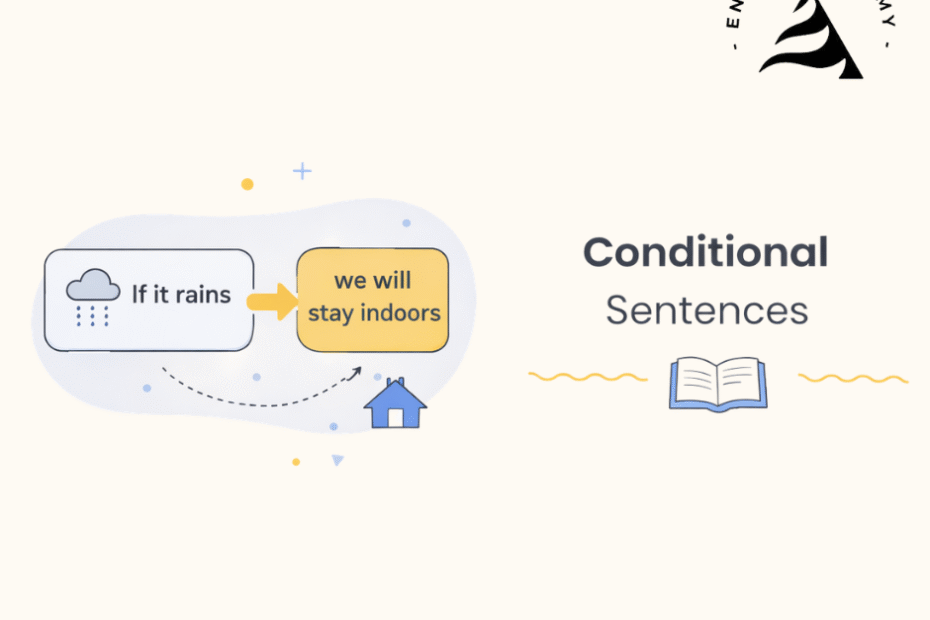
Conditional Sentences
Conditional sentences allow us to express possibilities, hypothetical situations, and cause-effect relationships. They help us navigate the complex world of "what if." Different types of conditionals are as follows:
Zero Conditional
1. Use
General facts and laws of nature.
2. Form
If clause | Main clause |
Simple Present | Simple Present |
3. Examples
If clause | Main clause | |
If you freeze water, | it expands. | |
If you mix yellow and red, | you get orange. | |
Main clause | If clause | |
You get orange | If you mix yellow and red. | |
The word ‘if’ can almost always be substituted with ‘when’ without changing the meaning.
First Conditional
1. Use
It is possible to fulfil a condition which is given in the if-clause.
2. Form
If clause | Main clause |
Simple Present | will-future |
infinitive | |
Modal + infinitive |
3. Examples
If clause | Main clause |
If I study, | I will pass the exams. |
If you see John tonight, | tell him to e-mail me. |
If Ben gets up early, | he can catch the bus. |
The if-clause can be at the beginning or at the end of a sentence. Mind the comma.
If clause | Main clause | ||
If I study, | I will pass the exams. | ||
Main clause | If clause | ||
I will pass the exams | if I study. | ||
Second Conditional
1. Use
It is theoretically possible to fulfil a condition which is given in the if-clause.
2. Form
If clause | Main clause |
Simple Past | would + infinitive |
could + infinitive | |
might + infinitive |
3. Examples
If clause | Main clause |
If I studied, | I would pass the exams. |
If I studied, | I could pass the exams. |
If I studied, | I might pass the exams. |
If he got more pocket money, | he would ask Reena out. |
If Ravi went to the cinema, | he would watch a comedy film. |
The if-clause can be at the beginning or at the end of a sentence. Mind the comma.
If clause | Main clause | ||
If I studied, | I would pass the exams. | ||
Main clause | If clause | ||
I would pass the exams | if I studied. | ||
Third Conditional
1. Use
It is impossible to fulfil a condition which is given in the if-clause. It’s too late to do so.
2. Form
If clause | Main clause |
Past Perfect | would + have + past participle |
could + have + past participle | |
might + have + past participle |
3. Examples
If clause | Main clause |
If I had studied, | I would have passed the exams. |
If I had studied, | I could have passed the exams. |
If I had studied, | I might have passed the exams. |
- gg
Mixed Conditional
We can use mixed conditionals when we imagine:1) a past change with a result in the present or 2) a present change with a result in the past.
Use 1. Past/Present
A change in a past situation would have a result in the present.
Form
If clause | Main clause |
Past Perfect | would + infinitive |
Examples
If clause | Main clause |
If we had bought that house, | we would be rich now. |
If my parents hadn’t met, | I wouldn’t be here now. |
If Ravi hadn't got the job in Mumbai, | he wouldn't be with Neha. |
Use 2. Present/Past
A present change with a result in the past.
Form
If clause | Main clause |
Simple Past | would + have + past participle |
Examples
If clause | Main clause |
If it weren’t really important, | I wouldn’t have called you on your holiday |
If I lived closer to work, | I would have arrived earlier yesterday. |
If he were more organized, | he would have finished the project on time. |
-2022
- Gerund and Infinitive
- Modal Auxiliaries, Modals
- Nouns
- Participles
- Passive Voice
- Phrasal Verbs
- Prepositions
- Pronouns
- QuantIfiers
- Questions
- Reported Speech
- Sentences
- Tenses
- Various
- Verbs
- ALL Explanations
© 1999-2022