The Present Perfect Tense: A Guide for Indian Learners
Imagine you are at an interview for a position at Infosys in Bangalore. The interviewer looks at your resume and asks, "Have you ever worked on a global project?" or "How long have you lived in this city?" You are not just talking about the past; you are talking about how your past experiences connect to who you are right now. In Indian English, we often use the Simple Past for everything, but mastering the Present Perfect is the secret to sounding professional and precise both in exams like the IELTS and in daily office conversations.
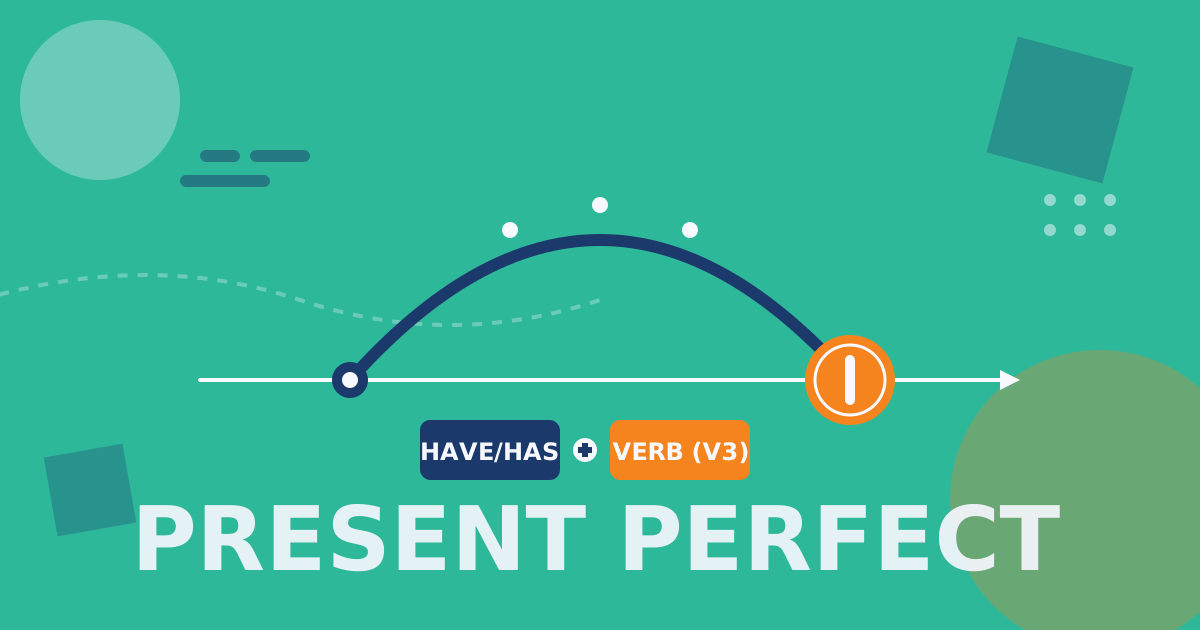
The Present Perfect Tense connects the past to the present. It is formed using: Subject + have/has + Past Participle (V3). Use it for actions that happened at an unspecified time or actions that started in the past and continue now.
1. Forming the Present Perfect
To build a sentence in this tense, you need two things: a helping verb (have or has) and the third form of the verb (V3). Many Indian learners struggle with irregular verbs—remember, it is not "I have ate," it is "I have eaten."
| Subject | Helping Verb | Main Verb (V3) | Example |
|---|---|---|---|
| I / You / We / They | have | worked / eaten / gone | I have finished my lunch. |
| He / She / It / Ravi | has | worked / eaten / gone | Neha has sent the email. |
Regular: Simply add -ed (Work → Worked, Play → Played).
Irregular: These change completely (Go → Gone, Eat → Eaten, Write → Written, See → Seen).
✏️ Quick Practice — Verb Forms
- She ______ (write) three letters today.
- We ______ (see) that movie at PVR already.
- Arjun ______ (buy) a new bike for Diwali.
Answers: 1. has written | 2. have seen | 3. has bought
2. Use 1: Life Experience (Ever/Never)
We use this tense to talk about things we have done in our lives without saying exactly when. If you specify the time (like "yesterday"), you must use the Simple Past. But if you are talking about the experience itself, use the Present Perfect.
✅ Question (Ever): "Have you ever been to Shimla?"
✅ Negative (Never): "I have never tasted South Indian filter coffee."
✅ Positive: "Ravi has travelled to five different countries."
| Specific Trip / Time (Simple Past) | General Experience (Present Perfect) |
|---|---|
| Did you go to Mumbai? (asking about a specific occasion) | Have you been to Mumbai? (asking about life experience) |
| I went to Mumbai last year. (specific time stated — simple past required) | I have been to Mumbai. (general experience, no time specified) |
3. Use 2: Recent Past with Present Result
This is very common in office settings. Use this when an action happened recently and the result is still important right now. If Neha loses her keys, and she is still looking for them, she says, "I have lost my keys."
✅ Action: The rain started. Present Result: The ground is wet now. → "It has rained."
✅ Action: Rahul broke his phone. Present Result: He cannot call anyone now. → "Rahul has broken his phone."
✅ Action: Someone ate the sweets. Present Result: The box is empty now. → "Who has eaten all the laddoos?"
4. Use 3: Unfinished Time (For/Since)
This is where many Indian students make mistakes by using the Present Continuous. Instead of saying "I am living here since five years" (❌), you must say "I have lived here for five years" (✅).
| Word | Usage | Example |
|---|---|---|
| For | Duration (how long) | "I have worked at this school for ten years." |
| Since | Starting point (specific date/time) | "Priya has been ill since Monday." |
| For | General duration | "They have known each other for a long time." |
| Since | A specific event in the past | "We have lived in Delhi since the move." |
✏️ Quick Practice — For vs. Since
- I have studied English ______ three months.
- My father has worked in the bank ______ 1995.
- We haven't met ______ the last wedding.
Answers: 1. for | 2. since | 3. since
5. Use 4: Just, Already, and Yet
These three words are the best friends of the Present Perfect tense. They help us define exactly how "recent" or "expected" an action is.
✅ Just: A very short time ago. → "I have just finished the meeting."
✅ Already: Sooner than expected. → "He has already paid the electricity bill."
✅ Yet: Expected to happen (used in negatives and questions). → "Has the train arrived yet?" / "The results haven't come yet."
Always place 'just' between have/has and the V3 verb. Usually place 'already' between have/has and the V3 verb (though it can also appear at the end of a sentence for emphasis). Place 'yet' at the very end of the sentence.
6. Present Perfect vs. Simple Past
This is the most important distinction for competitive exams like UPSC or SSC.
| Present Perfect | Simple Past |
|---|---|
| No specific time mentioned. | Specific time mentioned (yesterday, in 2010). |
| The result matters now. | The action is finished and stayed in the past. |
| "I have seen the Taj Mahal." | "I saw the Taj Mahal in 2018." |
| "He has left the office." (He is gone now) | "He left the office at 5 PM." (Focus on the time) |
7. Common Mistakes by Indian Learners
In many Indian languages, we use the same structure for "I didn't do it" and "I haven't done it." This leads to common errors in English.
| ❌ Incorrect | ✅ Correct | Why? |
|---|---|---|
| I didn't meet him yet. | I haven't met him yet. | 'Yet' requires the Present Perfect tense. |
| He has went to the market. | He has gone to the market. | Always use V3 (gone) after has, not V2 (went). |
| I have seen that movie yesterday. | I saw that movie yesterday. | You cannot use Present Perfect with a specific past time. |
| I am knowing him for years. | I have known him for years. | Use Present Perfect for states that started in the past. |
✏️ Quick Practice — Correct the Mistakes
- She has went to the office.
- We have bought this car last year.
- They are living here since 2010.
Answers: 1. She has gone to the office. | 2. We bought this car last year. | 3. They have lived here since 2010.
Summary
The Present Perfect tense is your bridge between the past and the present. It tells your listener that what happened before is still relevant now.
- Use have/has + V3 form.
- Use it for life experiences (ever/never).
- Use it for recent actions with present results.
- Use for for duration and since for a starting point.
- Never use it with specific past time markers like "yesterday" or "last week."
Key takeaway: To practise, try describing your day using "already" and "yet." For example, "I have already had tea, but I haven't started my homework yet." This will help you naturally switch between the present and the past.