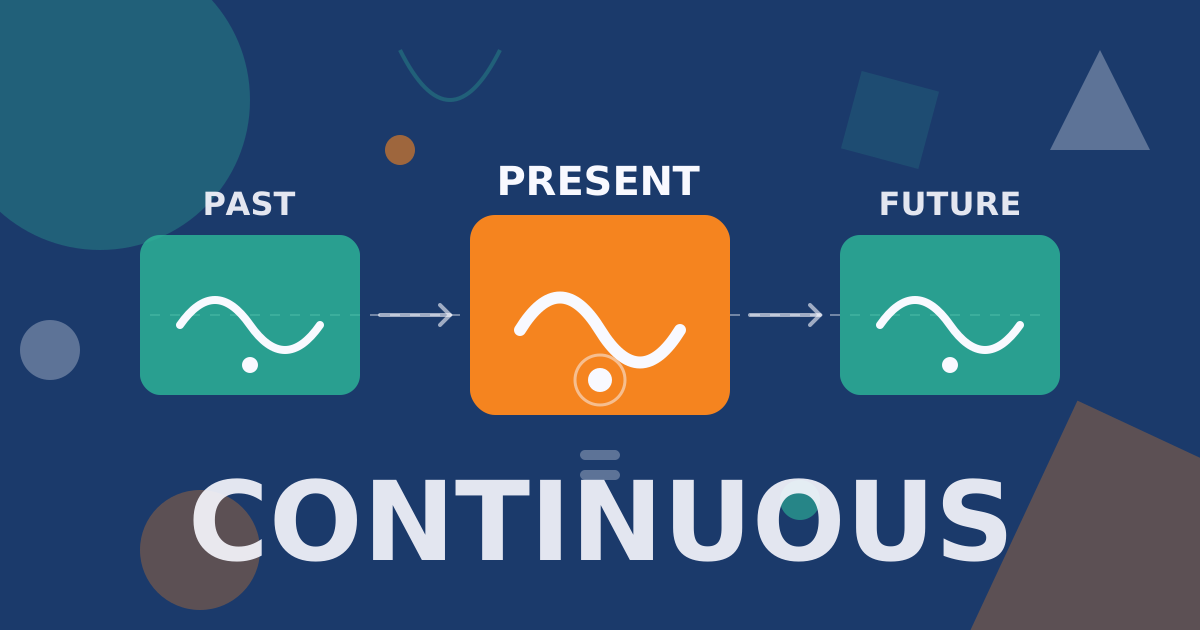
Understanding Present, Past, and Future Continuous Tenses
It’s 6:00 AM at Vidya Niketan Hostel. Students are waking up, stretching in yoga class, ironing uniforms, and rushing to catch the 6:15 AM bus. Notice how every action is happening right now. This is the world of continuous tenses — and they don’t just describe the present. They can also take us into the past or future to show actions that were (or will be) in progress at a specific time.
Continuous tenses show actions in progress at a particular time. They use a form of be (am/is/are, was/were, will be) + verb-ing.
1. Present Continuous Tense
We use the present continuous to describe:
- An action happening right now or around now.
- A planned future action (personal arrangements).
- A changing or developing situation.
✅ Sharma Ma’am is teaching yoga right now.
✅ We are eating out tonight.
✅ India is progressing day by day.
Structure
| Type | Structure | Example |
|---|---|---|
| Positive | Subject + am/is/are + verb-ing | She is reading a book. |
| Negative | Subject + am/is/are + not + verb-ing | He is not coming with us. |
| Question | Am/Is/Are + subject + verb-ing? | Are they talking? |
| Wh- Question | Wh- word + am/is/are + subject + verb-ing? | Why is Ravi shouting? |
2. Past Continuous Tense
The past continuous describes an action that was in progress at a specific time in the past. It is often used with another action (in simple past) that interrupts it.
✅ The light went out while I was reading.
✅ They were going to Mahabaleshwar when they met with an accident.
✅ He was talking to the principal about the annual function.
Structure
| Type | Structure | Example |
|---|---|---|
| Positive | Subject + was/were + verb-ing | She was writing a letter. |
| Negative | Subject + was/were + not + verb-ing | They were not talking during the meeting. |
| Question | Was/Were + subject + verb-ing? | Were you listening to me? |
| Wh- Question | Wh- word + was/were + subject + verb-ing? | What were you doing when I called? |
3. Future Continuous Tense
We use the future continuous to talk about:
- An action that will be in progress at a specific future time.
- A planned future action that will continue for a period.
✅ This time tomorrow, I will be writing my exam.
✅ Neha will be working from 9 AM to 6 PM this week.
✅ Please don’t come at 8 PM. I will be watching the news.
Structure
| Type | Structure | Example |
|---|---|---|
| Positive | Subject + will be + verb-ing | She will be staying here till Sunday. |
| Negative | Subject + will not be + verb-ing | He will not be travelling first class. |
| Question | Will + subject + be + verb-ing? | Will Ravi be travelling first class? |
| Wh- Question | Wh- word + will + subject + be + verb-ing? | Where will you be waiting for us? |
Common Mistakes & Key Points
Present Continuous vs. Simple Future: Use present continuous for planned personal arrangements. Use simple future for unplanned or spontaneous decisions.
| Spontaneous / Prediction (Will) | Planned Arrangement (Present Continuous) |
|---|---|
| We will eat out tonight. (spontaneous decision) | We are eating out tonight. (pre-arranged plan) |
| My uncle will arrive tomorrow. (prediction) | My uncle is arriving tomorrow. (confirmed schedule) |
Will go vs. be going to: Both can express future plans, but “be going to” emphasises a decision already made.
✅ The PM is going to visit Paris next week. (already arranged)
✅ Maybe we will go to Khandala. (not yet decided)
Stative Verbs: Some verbs (e.g., think, want, like, taste, wish) are not used in continuous forms when they describe states, not actions.
| ❌ Incorrect | ✅ Correct |
|---|---|
| I am thinking you are wrong. | I think you are wrong. |
| These grapes are tasting sour. | These grapes taste sour. |
| I am wanting to become a doctor. | I want to become a doctor. |
✏️ Quick Practice — Fill in the blanks
- Right now, the students ________ (attend) their online class.
- At 5 PM yesterday, I ________ (watch) a movie with my friends.
- This time next week, we ________ (travel) to Shimla.
- She ________ (not / come) to the party tomorrow. She has other plans.
- Look! The children ________ (play) cricket in the park.
- When I called you, what ________ you ________ (do)?
- They ________ (build) a new house next month. (planned action)
- I ________ (think) this is a bad idea. (opinion, not action)
Answers: 1. are attending | 2. was watching | 3. will be travelling | 4. is not coming | 5. are playing | 6. were, doing | 7. are building | 8. think
Summary
Continuous tenses help us describe actions in progress at a specific time — whether in the present, past, or future. Remember: be (am/is/are, was/were, will be) + verb-ing. Use present continuous for now or planned future actions, past continuous for actions interrupted in the past, and future continuous for actions that will be ongoing at a future time.
Key takeaway: Continuous tenses bring actions to life by showing them happening, not just completed. Master them, and your English will sound more natural and dynamic.