How to Learn Phrasal Verbs Without Memorising Long Lists
Ravi was sitting in a high-pressure project meeting at an IT firm in Bengaluru. His manager said, “We need to drill down into these numbers before we hand over the module to the client.” Ravi understood the words drill and hand, but the combinations felt like a secret code. Later that night, he opened a thick grammar book and saw an alphabetical list: Act on, Act out, Act up... He gave up by the time he reached the letter B.
If you have tried to memorise phrasal verbs alphabetically, you have been fighting an uphill battle. Human brains do not store language in alphabetical folders; we store it in patterns. Learning phrasal verbs like a dictionary is like trying to learn the names of everyone in Mumbai by reading the phone book.
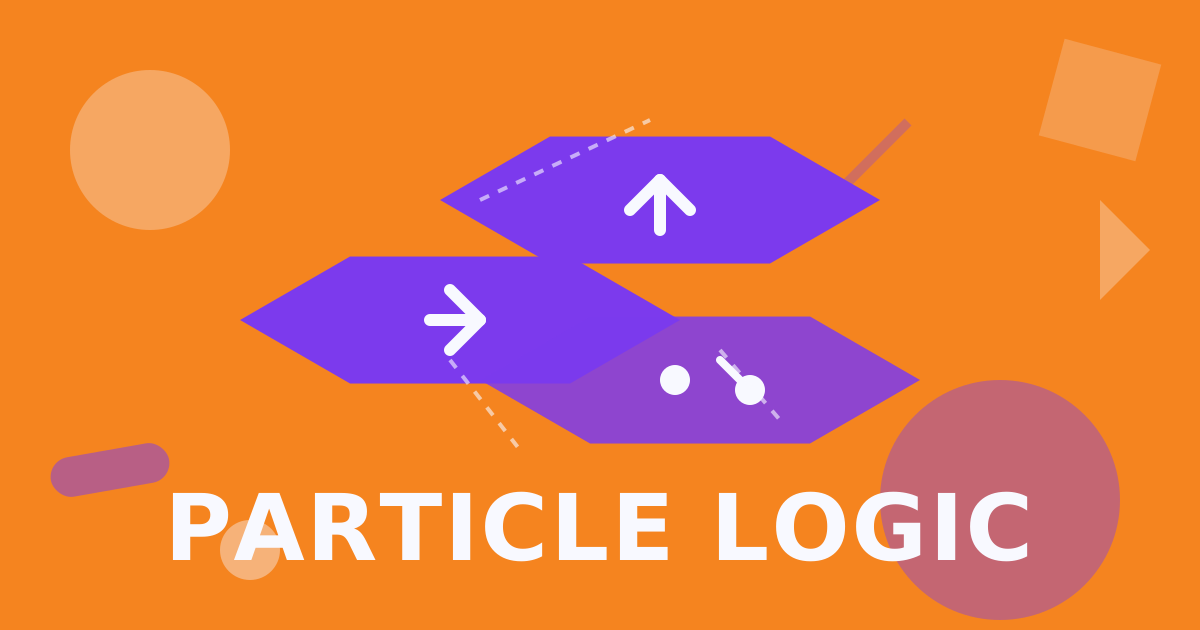
There is a better way. To master phrasal verbs, you need to stop looking at the verb and start looking at the particle — the small word like up, off, out or down.
The Secret: The Particle System
In a phrasal verb, the verb (like go, take or set) often loses its original meaning. The particle is where the logic lives. When you understand what Up or Off usually suggests, you can guess the meaning of hundreds of new verbs without a dictionary.
The Power of “Up” (Completion or Improvement)
In English, Up often means finished, completely or making something better.
- Clean up: Don’t just clean; clean until the room is perfect. “Priya, clean up your desk before the client visit.”
- Drink up: Finish your chai completely.
- Wrap up: To finish a meeting or a task totally. “Let’s wrap up this call; I have another meeting at 4 PM.”
- Brush up: To improve a skill you have not used in a while. “I need to brush up on my Java skills before the TCS interview.”
The Logic of “Off” (Separation or Departure)
Off usually indicates moving away from a point or stopping a connection.
- Take off: The plane leaves the ground (separation).
- Call off: To cancel something (separating the event from the schedule). “The cricket match was called off due to rain in Chennai.”
- Set off: To start a journey. “We set off for the airport at 5 AM to avoid the Mumbai traffic.”
Stop Alphabetising, Start Grouping
Instead of learning Go away, Go on, Go through, look at how a single verb changes its personality based on the particle. Let’s look at the verb Break — a favourite in both IELTS exams and office talk.
| Phrasal Verb | The Logical Pattern | Indian Context Example |
|---|---|---|
| Break down | Down = Failure/Stop | “My scooter broke down near Silk Board junction.” |
| Break up | Up = Completion/End | “After the long-distance struggle, Ravi and Neha decided to break up.” |
| Break out | Out = Sudden release | “A fire broke out in the warehouse near the Delhi border.” |
| Break through | Through = Passing a barrier | “The scientists finally broke through in their vaccine research.” |
The Professional 20: Essential Phrasal Verbs for Indian Offices
You do not need 2,000 phrasal verbs. You need the 20 that appear in every email and Zoom call. Group them by their functional use:
For Productivity and Execution
- Get through: To finish a large amount of work. “I have so many emails to get through before EOD.”
- Knuckle down: To start working very hard. “With exams approaching, it is time to knuckle down.”
- Fill in: To complete a form or provide information. “Please fill in your Aadhaar details here.”
- Follow up: To check the status of something later. “I will follow up with HR regarding your offer letter.”
These verbs help you describe progress and effort clearly, whether you are managing deadlines or updating your team.
For Meetings and Communication
- Bring up: To mention a topic. “Don’t bring up the budget issue during the stand-up call.”
- Circle back: To discuss something again later. “Let’s circle back to this after we see the sales data.”
- Point out: To draw attention to a fact. “Rohan pointed out a bug in the code just before the release.”
- Spell out: To explain something in very simple detail. “I need you to spell out exactly how this new policy affects my PF.”
Using these phrasal verbs makes your communication more natural and precise, especially in professional discussions.
For Problems and Changes
- Deal with: To handle a problem. “The customer service team is dealing with the surge in complaints.”
- Sort out: To find a solution. “Don’t worry about the booking error; I’ll sort it out with the hotel.”
- Back out: To withdraw from a commitment. “The investor backed out of the deal at the last minute.”
- Work out: To find a solution or result. “We are trying to work out a way to reduce costs.”
For Social and Professional Growth
- Take on: To accept a new responsibility. “She decided to take on the role of team lead.”
- Look up to: To admire someone. “Many young engineers look up to Narayana Murthy.”
- Fit in: To belong in a group. “It took a few weeks for the new hire to fit in with the Mumbai team.”
- Stand out: To be noticeably better than others. “Your presentation really stood out today.”
For Daily Operations
- Run by: To show an idea to someone for approval. “Let me run this by my manager before I say yes.”
- Look over: To check or examine quickly. “Could you look over my resume before I hit send?”
- Go over: To review something in detail. “Let’s go over the contract one more time.”
- Set up: To arrange or establish. “I’ll set up a meeting for Friday morning.”
Avoid These Common Indian English Mistakes
In India, we often add extra prepositions where they are not needed, or use the wrong phrasal verb entirely.
| ❌ Incorrect | ✅ Correct |
|---|---|
| “I will discuss about the matter.” | “I will talk over the matter.” OR “I will discuss the matter.” |
| “Please revert back to my email.” | “Please get back to me” OR “Please reply to my email.” |
| “The light has gone.” (meaning the power is cut) | “The power has gone out.” (Saying “the light has gone” is an Indianism meaning the electricity is cut. In standard English, use “gone out” to describe a power failure.) |
Your Workflow: How to Learn in the Wild
When you are reading The Hindu or watching a show like Panchayat, do not just ignore a phrasal verb you do not know. Follow this 3-step workflow:
- Isolate the Particle: Is it Out? Is it Back? Does that give you a hint of the “vibe” of the word?
- Guess from Context: If the sentence is “The company pushed back the product launch,” and you know they were having supply issues, you can guess it means postponed.
- Personalise Immediately: Do not just write the definition. Write a sentence about your life.
Bad: Postpone = to put off.
Good: “I had to put off my trip to Goa because of my sister’s wedding.”
Final Thought
Stop relying on alphabetical lists that confuse your brain by making everything look the same. Focus on the particle, group phrasal verbs by theme, and always learn them in context. Master the system, not the list, and phrasal verbs will finally make sense.