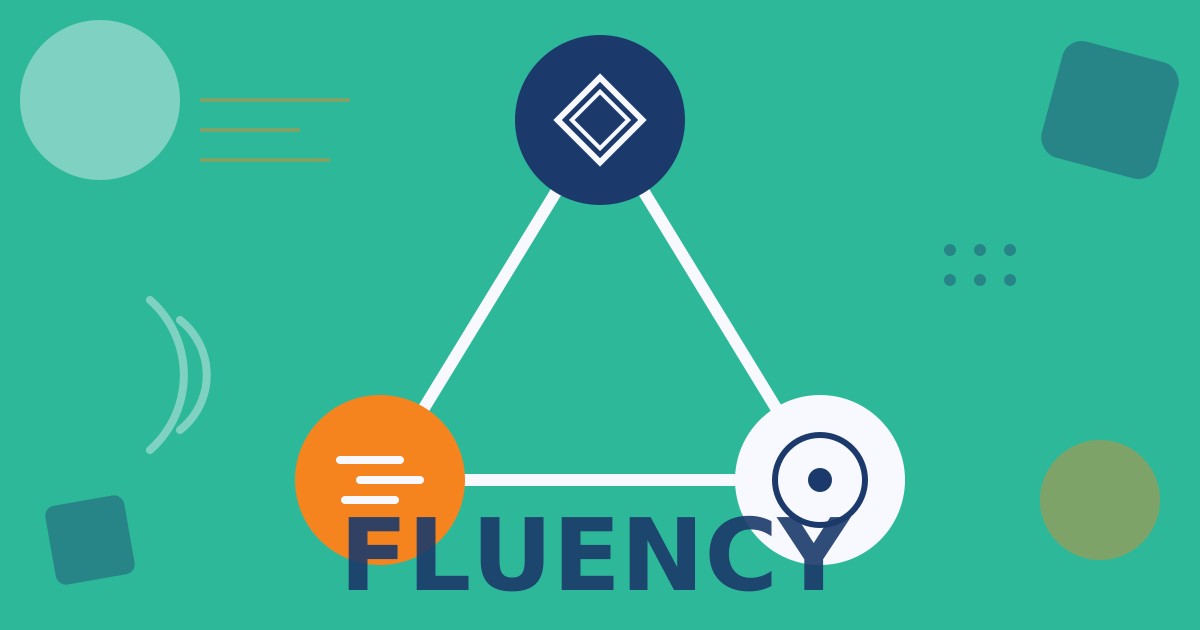
The Fluency Triangle: Balancing Speed, Accuracy, and Complexity in English Speaking
Struggling to speak English smoothly, correctly, and expressively all at once? You’re not alone. Many learners find that when they focus on speaking quickly, their grammar slips; when they aim for perfect accuracy, their speech becomes slow and stiff; and when they try to sound advanced, they stumble over complex sentences. The Fluency Triangle is a simple yet powerful way to understand and balance these three essential elements of confident English speaking.
What Is the Fluency Triangle?
The Fluency Triangle is a framework that highlights three interconnected components of effective spoken English: speed, accuracy, and complexity. Think of them as the three corners of a triangle—pull too hard on one, and the others weaken. Mastering all three is what makes your speech natural, clear, and impactful.
The Three Points of the Fluency Triangle
1. Speed (Pace)
This refers to how quickly and smoothly you can speak without unnatural pauses or excessive hesitation. The goal isn’t to race through your words but to maintain a natural, steady flow that keeps listeners engaged. Native speakers don’t rush; they glide—and that’s the pace you should aim for.
2. Accuracy
Accuracy covers correct grammar, precise vocabulary, and clear pronunciation. While minor mistakes won’t always derail communication, consistent errors can confuse your listener. Strive for a level of accuracy that ensures your message is understood the first time.
3. Complexity
Complexity is about the richness of your language: varied sentence structures, idiomatic expressions, and nuanced vocabulary. It’s the difference between saying “I like movies” and “I’m a huge fan of thought-provoking cinema”. The more complex your language, the more vivid and persuasive your speech becomes.
Why It’s Called a Triangle
The triangle metaphor illustrates that these three elements depend on each other. If you neglect one, the others suffer. A student who obsesses over accuracy might speak so slowly that their fluency feels robotic. On the other hand, someone who prioritises speed and complexity might make frequent errors that distract from their message. Balance is the key to sounding natural and confident.
How to Apply the Fluency Triangle to Your Learning
To develop balanced fluency, start by identifying which corner of the triangle needs the most work. Then, use targeted activities to strengthen each area. Here’s how:
Strengthening Speed
Build your ability to speak without hesitation with these exercises:
- Timed Talks: Pick a topic (e.g., “my favourite hobby” or “a memorable trip”) and speak non-stop for 1–2 minutes. Gradually increase the time as you get comfortable.
- Shadowing: Listen to a podcast, TED Talk, or audiobook at natural speed. Repeat the words simultaneously or with a minimal delay behind the speaker, without pausing the audio, to match their pace, rhythm, and intonation.
These activities train your brain to think and speak in real time, reducing the gap between your thoughts and your words.
Improving Accuracy
Fine-tune your grammar, vocabulary, and pronunciation with controlled practice:
- Record and Self-Correct: Record yourself speaking for 2–3 minutes on a topic. Transcribe what you said, identify errors, and re-record with corrections.
- Reformulation Practice: Ask a teacher or language partner to listen to your speech and then model back a more accurate version. Compare the two to spot areas for improvement.
| Incorrect | Corrected |
|---|---|
| I go to market yesterday. | I went to the market yesterday. |
| She don’t like tea. | She doesn’t like tea. |
Adding Complexity
Elevate your language with these advanced techniques:
- Sentence Combining: Take two simple sentences (e.g., “I woke up late. I missed the bus.”) and combine them using conjunctions or relative clauses (“Because I woke up late, I missed the bus.”).
- Vocabulary Challenges: During conversations, challenge yourself to use at least three advanced words or phrasal verbs (e.g., “postpone,” “embark on,” “anticipate”).
- Genre Switching: Explain the same idea in different registers. For example, describe your weekend first in a casual chat with a friend, then as a formal presentation to colleagues.
These exercises help you move beyond basic structures and sound more like a natural, expressive speaker.
Final Thought
The Fluency Triangle reminds us that great speaking isn’t about mastering just one skill—it’s about harmonising speed, accuracy, and complexity. Start by assessing your strengths and weaknesses, then practise deliberately. With time and consistency, you’ll find your natural rhythm, clarity, and richness—the hallmark of a truly fluent speaker.